Jims Rubbish Modern Slavery Statement
 Jims Rubbish publishes this Modern Slavery Statement to set out our commitment to preventing slavery and human trafficking in our operations and supply chain. This anti-slavery declaration reflects our core values: respect for people, lawful employment practices and accountability across every service we provide. We adopt a zero tolerance approach to any form of forced labour, servitude or human trafficking and will act decisively where any risk is identified.
Zero-Tolerance Policy and Corporate Commitment
We operate a clear zero-tolerance policy towards modern slavery. Senior management and the board require all staff and contractors to comply with our standards and to challenge any unacceptable practices. Our anti-slavery policy is embedded in employment contracts and our procurement expectations. We regularly communicate that Jims Rubbish will not tolerate exploitation, whether identified as part of our domestic operations or within the extended supply chain.
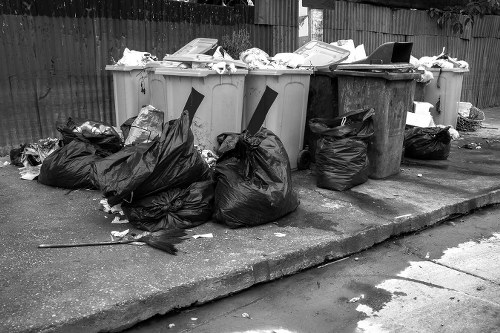
![A row of five large blue wheelie bins positioned outdoors on a paved surface against a plain grey concrete wall, with four bins filled with discarded cardboard boxes, paper, and miscellaneous office waste. The waste materials include flattened cardboard sheets, crumpled papers, and black plastic bags spilling over the edges of some bins, indicating recent use. The first bin on the left is partially covered with its lid, while the second, third, and fourth bins have their lids open or removed, revealing the clutter inside. In front of the bins, on the pavement, there is a small, white, plastic container lying on its side. The scene captures a typical rubbish disposal area, consistent with waste management services provided by Jims Rubbish, situated in a town environment, possibly within [POSTCODE], as part of general rubbish collection and disposal operations.](/pub/_photos/rubbish/f1340881416.jpg) Our supplier obligations include contractual clauses that require compliance with our modern slavery policy and give us the right to audit and terminate relationships where breaches occur. We expect suppliers to uphold equivalent standards and to provide evidence of lawful pay, working hours and treatment of workers. Where necessary, we will require corrective action plans and we reserve the right to suspend or end contracts for non-compliance.
Our supplier obligations include contractual clauses that require compliance with our modern slavery policy and give us the right to audit and terminate relationships where breaches occur. We expect suppliers to uphold equivalent standards and to provide evidence of lawful pay, working hours and treatment of workers. Where necessary, we will require corrective action plans and we reserve the right to suspend or end contracts for non-compliance.
Supplier audits and due diligence form a cornerstone of our prevention strategy. We conduct risk-based supplier assessments prior to onboarding and perform ongoing reviews proportionate to the level of risk. Audits include documentation checks, on-site inspections and third-party verifications. Findings lead to tailored remediation and continuous monitoring to ensure compliance with our anti-slavery commitments.
Reporting Channels and Safe Speak-Up Mechanisms
 Jims Rubbish provides multiple reporting channels for concerns about modern slavery, exploitation or unethical labour practices. Employees, contractors and third parties can raise issues confidentially and, if desired, anonymously. Reports are treated seriously: they are investigated promptly and impartially, with protections in place to safeguard reporters from retaliation. We will act on substantiated concerns and take appropriate remedial steps.
Our whistleblowing and grievance mechanisms are supported by training for managers and staff so that suspected incidents are recognised early. We also include specific reporting expectations in supplier agreements and require suppliers to maintain their own adequate reporting routes. These channels are part of our broader compliance framework designed to ensure transparency and responsiveness.
We emphasise continuous improvement through regular monitoring, remediation and collaboration. Our approach to tackling modern slavery combines internal audits, supplier engagement, and targeted risk mapping in high-risk categories such as labour hire and logistics. Where exploitation is identified, Jims Rubbish will prioritise victim support, corrective action and recovery of ethical standards within affected operations.
 Accountability is enforced through governance and practical actions: procurement controls, contractual audit rights, and documented escalation procedures. We maintain a supplier code of conduct, provide training on responsible sourcing and require evidence of legitimate employment practices. Actions arising from audits are logged, tracked and closed only when full compliance is demonstrated.
 Annual review and public reporting ensure our anti-slavery statement remains current and effective. Each year we review risk assessments, audit outcomes and remedial actions, and we update policies and procedures accordingly. The board approves this modern slavery policy and receives regular updates on performance and material issues. Jims Rubbish will continue to strengthen due diligence, increase supplier engagement and embed responsible practices across our operations to prevent modern slavery and labour exploitation.